As I mentioned a few weeks ago, I’m developing an interesting project to provide programming talent to web startups in the states and perhaps other regions such as Europe. The concept continues to evolve with the focus now being on finding superstar programmers instead of the typical software factory with a variety of skill levels.
I really think that companies such as Globant have proven that, if done correctly, one can build a successful business by offering top-notch programming talent to interesting web companies. Realizing the potential of such an endeavor has as much to do with creating a vibrant company culture in tune with the needs of the programmers and the company’s potential customers. Here, in Colombia, I think a company such as Koombea, which has won international coding competitions, is further proof that the potential certainly exists.
Eventhough I’ve been looking forward to building my own web app (and a company around it), there are so many things pulling me in this direction, that I just can’t ignore it any longer. I’ve had qualms about going full force into a services business (like outsourced development), but, after further reflection, it’s finally clear to me that this path has a lot of positives.
Like I said, building a vibrant company culture is a big part of doing this successfully, but I’ve had great experiences doing this for others. Fifteen years ago, when I moved to Colombia from the states, I got the chance to build a services organization from 2 engineers to more than 20 at Compaq Computer and we achieved such a level of excellence that our country (Colombia) had the best customer satisfaction levels (our measure of success) in the whole world.
The incredible thing is that when I established that BHG (Big Hairy Goal) three years prior, I got a ton of snickers from the team and I’m sure they were convinced that they were dealing with one “gringo loco” (that part was true). Nevertheless, after five years in the valley (Silicon Valley) and a little flexibility in my adjustment to the Latin American culture, I saw that amazing things were possible.
I’m continuing to develop this project and will, firstly, make sure that I start locating top-notch talent before offering anything to potential customers (startups and other SaaS and web companies). I’d really like to get some young raw talent that can absorb a ton of high performance culture and values from Silicon Valley type companies instead of going whole hog for senior developers who might have acquired a few too many stodgy bad habits along the way.
What are your thoughts on what I’m embarking upon?

At the conferences where I speak, when I talk about Cloud Computing and the Software-as-a-Service (SaaS) model, one of my premises is that this new paradigm requires new competencies. More than ever, companies offering Software-as-a-Service need to be true to the “service” component and be responsive to customer requests.
Upon hearing this, many companies immediately think of customer service, which is indeed important. Nonetheless, many customers and non-customers offer suggestions that could or could not be of value to such organizations. Companies that hear their customers are also open so something called “open innovation” whereby innovations can come (in part or in whole) from outside the company’s boundaries.
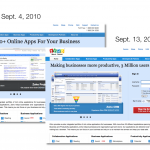
In terms of suggestions, one example revolves around the team at Zoho, a SaaS provider. As can be seen by the image at the top of this post the company made a slight change to its headline statement at the top of its web site between September 4th and the 13th of this year. About a year ago, I had the pleasure of interviewing the company’s founder and CEO, Sridhar Vembu and must admit I was quite impressed by his vision and intelligence. At that time, the company web site was little more than a listing of all their applications.
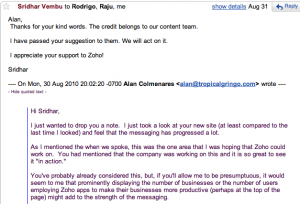
I asked Sridhar if they were thinking of revamping their messaging to focus on customer benefits and improve the general design of the site. He said they were and a couple of weeks ago, I stumbled upon the new site, which, in my mind, is an improvement. Nonetheless, in my email congratulating them on the new site, I did mention that it might be a good idea to include two messages: 1) Who Zoho makes companies more productive and 2) the millions of users they have. See my email below.
It says a lot that a few days later, they had taken action on these suggestions (from outside of their company) and implemented them. It was certainly possible that the suggestion would not have been implemented, but it is apparent that they take these suggestions seriously and are open to anything that helps them improve. This is a great lesson in whatever name you’d want to put on this (e.g., open collaboration, open innovation, etc.) for other SaaS providers and highlights the type of open company culture that such companies would do well to embrace.
I just got back from a great meeting with a fellow entrepreneur. He’s been working on building a dream team of partners to launch a top notch software development firm focused on cutting edge development that includes gaming, social networks and mobile (each project needs to include one or more of these). He has already built and sold a software development firm and has since learned a lot more do’s and don’ts and we will be launching in a couple of months.
We already have a team of more than ten engineers assembled and are close to negotiating a seed investment to get off to a running start. One of my jobs is to find interesting projects in the states and/or Europe. I will be reaching out to my contacts to find these. Many operations down here focus on small traditional projects in the local market, but we are focused on working on top tier projects with innovative companies (large and small).
The initial software development center will be based here in Colombia with the possibility of setting up additional centers in the most appropriate places (e.g., Asia, eastern Europe, etc.). We have some pretty impressive technical people (including architects). Nevertheless, I mentioned that we should look for a superstar CTO anywhere in the world and periodically fly that person down here to guide the technical team and develop the company vision. My friend was surprised by the suggestion, but he immediately saw the logic.
Thus, if you are superstar CTO material or know someone who is, please contact me. This position is for you if you’re into leading a team of eager learners and workers down here in Bogota, Colombia and are interested in fun international travel (reach out to anyone at the local embassy and they’ll tell you how much fun Colombia is – really, beyond what you’d expect). Obviously, the idea is for our new CTO to be a partner in the business and this would include becoming vested in the company.
Last week, I finished one of my SaaS workshops. Eight people registered (from four companies) to learn about SaaS models that have worked, different options of revenue streams and use new tools to get to a concrete set of actions to execute and develop a SaaS offering with much more chance of success.
Some of the quotes from the attendees: “The workshop confirmed to me that my understanding that continuous innovation in business is a reality”, “We now have tools to create a solid SaaS plan”, “We learned a ton!”, “The workshop allowed us to plan everything we need to plan,”the learnings from the workshop will allow us to convert our abstract ideas to concrete plans,”we now have new ideas for SaaS initiatives which we never had planned.”
In Latin America, Venture Capital is still scarce for startups, so there’s a big chance that the trailblazers will come from existing companies with profitable revenue streams. Nevertheless, there are already startups (such as JoinCube) that are off and running with their initiatives. This workshop is designed to get the group learning from each other and provides some conceptual models for team members to exchange ideas in order to, first, develop an original plan and, secondly, to iterate or “pivot” quickly as the project starts to take flight.
I will be giving this workshop in Colombia and then in other countries. There are two versions of the workshop. One is focused on developing SaaS offerings. The other is for employees of large companies in Latin America interested in taking advantage of digital innovation and understanding how, as John Hagel espouses in his white paper on the “Shift Index”, digital technologies are transforming industries such as banking, retail, tourism and media. Participants will make use of new tools to develop innovation initiatives for their companies while becoming literate on the “new world” that has come into being through digital technologies.
It’s been more than a month since my series of conferences on Cloud Computing at Microsoft’s Live events in Medellin, Cali and Bogota, Colombia. During the past few weeks, I’ve been able to do more reconnoissance of the market’s readiness for these offerings. What I’ve found is that there are very few local ISVs with Software-as-a-Service (SaaS) offerings, but quite a few players are offering open source and other third party software hosted on the cloud.
Additionally, from my own clients (software companies) and others, I’ve seen keen interest in developing new offerings leveraging the cloud. Nevertheless, there are many options and much confusion as to how to proceed. Developing a solid SaaS solution takes a lot more than simply hosting on the cloud and that is where the true opportunity to differentiate your software company lay.
This is going to be quite an interesting year and I am going to have the opportunity to help my current clients and some new ones that should be hiring me soon. My objective is to have each client understand the power of a SaaS offering and to set a clear objective for the same.
In my last post, I spoke about my conversation with Sridhar Vembu, CEO of Zoho Corporation, an innovative software company headquartered in the US, but with most of their employees based in India and China. I wrote mostly about the ingredients of the company’s success. In this post, I’d like to delve a bit further into Sridhar’s vision and philosophy and its applicability to Latin America.
While I was speaking with Sridhar, I was reminded of John Hagel’s book, The Only Sustainable Edge. In it, Hagel mentions two important areas touched upon by the Zoho CEO. The first one has to do with Zoho’s ability to offer customers value at an affordable cost which is in synch with Hagel’s assertion that technology innovations are opportunities to “create more value at less cost.” Zoho’s location, recruiting, training and company culture paired with its bet on cloud computing make are certainly aligned to a goal of creating more value at less cost for their customers. Additionally, Hagel points out in his book that managing across two cultures “can create new opportunities to enhance performance by drawing on the best of both cultures.” Certainly, this is not news to Sridhar who lives and breathes it every day. (more…)
A couple of days ago, I had the opportunity to talk with Sridhar Vembu, CEO of Zoho Corp, a strong player in the SaaS software market. The company’s corporate headquarters are in Pleasanton, California and the majority of it’s about 1000 employees are based out of India and China. These and other characteristics make Zoho and Sridhar, who has spent half his life in India and half (presently) in the states, an excellent model for digital innovation in Latin America.
First off, what really struck me about Sridhar after our chat was the balance of three key characteristics of his personality that came across: 1) His passion for the “people aspect” of building a business, 2) his practicality and incisive thoughtfulness and, finally, 3) an underlying, intense pride (in his people, what they’ve accomplished, etc.) and competitiveness. Incidentally, my own opinion is that this type of open personality, high level of intelligence, balanced outlook and strong personal drive will be key leadership traits for achieving success in the coming years, but that’s a topic for another post. (more…)